
Most companies start a partner program by copying the visible parts of somebody else's program. They create tiers. They write a referral agreement. They buy partner software. They announce a few logos. Then they wait for introductions. Very little happens. The problem started before the program launched: nobody defined why another company would help them grow.
Here is the basic answer. A business partnership works when a customer gets a better outcome and both companies gain enough value to repeat the work. The partner contributes an asset your company lacks. Your company returns value the partner cares about. The customer gives the exchange a reason to exist. Everything else is program design.
A signed agreement is not a partnership
An agreement records terms. A partnership creates repeated behavior. That difference matters because partnership teams often measure administrative progress: agreements signed, partners listed, integrations announced, people trained, portal logins. Those items can support a working motion. None of them proves that a working motion exists.
A partnership exists when both companies perform a useful action more than once. The action could be an introduction, a joint sale, an implementation, a product connection, or a service delivered under another brand. The action must produce value for a real customer, and both companies must have a reason to do it again. That is the standard.
Start with the three-party system
Every B2B partnership has three economic parties: the customer, the partner, and your company. Weak partnership plans focus on two of them. The vendor wants distribution. The partner wants commission. The customer appears near the end of the deck as a vague beneficiary. That order creates shallow programs, because the customer outcome controls the rest of the system.
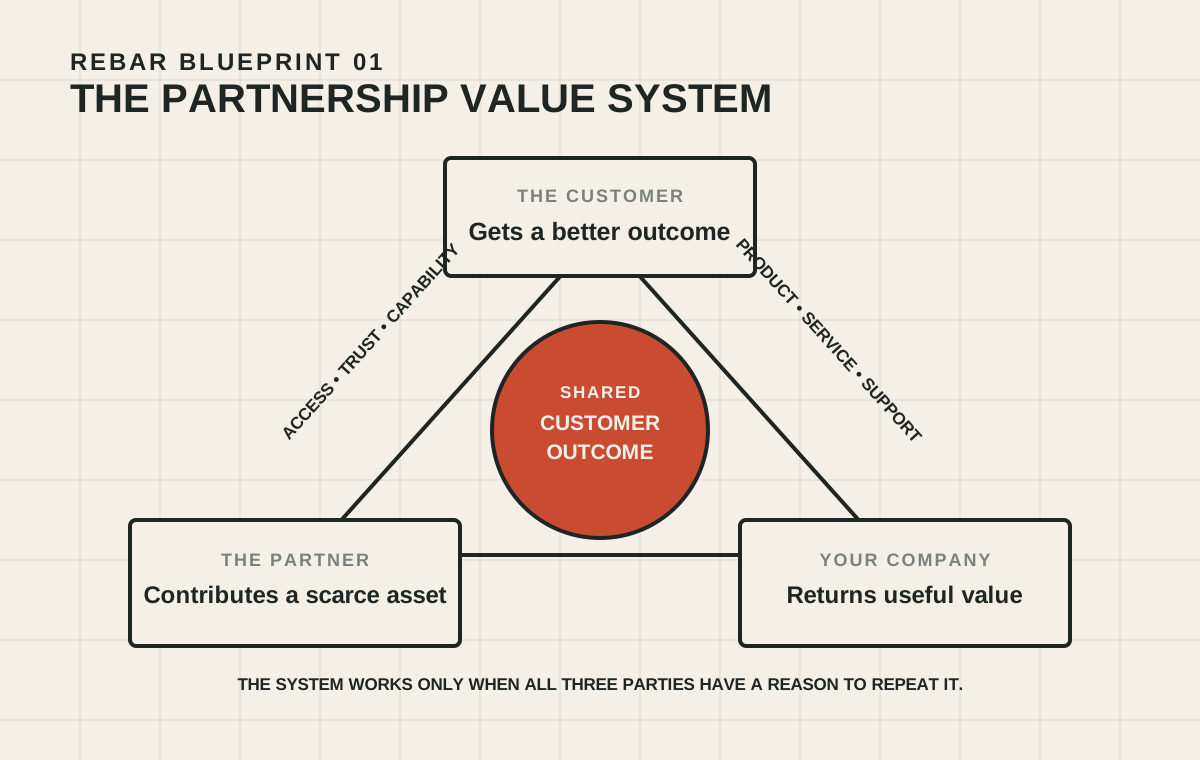
The customer must get a better outcome. They need a concrete reason to buy through the partnership: less implementation work, lower perceived risk, a more complete solution, faster time to value, one contract instead of several, advice from a company they already trust, or access to something previously hard to buy. If the partnership only helps the two vendors, the customer becomes an unwilling middleman. Sales cycles get longer, support gets harder, and the offer feels assembled for a press release.
The partner must gain something it already values. Most pitches assume revenue share creates motivation, but revenue share motivates only when the expected return exceeds the work and risk. Partners can gain new revenue, better retention, higher account value, a stronger product or service, access to a new market, lower delivery cost, protection against a competitor, or more useful customer data within legal limits. The partner must care about the value now; a benefit that might matter after a future launch usually has little present value.
Your company must gain an economic advantage. Partner revenue can look attractive while losing money underneath. Your company needs a measurable gain, such as lower customer acquisition cost, faster sales cycles, higher conversion, larger contracts, better retention, access to buyers your team cannot reach efficiently, delivery capacity you do not want to build, or a product advantage that improves the core offer. The advantage must cover the cost of commission, enablement, technical work, partner management, and added complexity.
The partner must own a scarce asset
A company is not a useful partner because it serves the same market. Market overlap creates a possibility. A scarce asset creates leverage. Useful partners usually control at least one of five assets.
- Customer access — the partner can reach buyers you cannot reach at the same cost or speed. A payroll platform serves thousands of employers; an association has a direct line to a narrow community. An email list alone is not access; the partner needs permission and a credible reason to introduce your offer.
- Trust — the partner has earned belief from the buyer, which matters most when the purchase carries financial, technical, operational, or reputational risk. Trust has a domain: a customer can trust an advisor on tax and ignore the same advisor on cybersecurity.
- Complementary capability — the partner completes a customer outcome your product cannot deliver alone. The combined offer should solve one larger problem; two products on the same page are not a solution.
- Workflow position — the partner already sits inside the process where the customer discovers, evaluates, buys, or uses your category, so the partnership can appear at the moment of need instead of relying on memory.
- Service capacity — the partner can sell, configure, implement, or support work your team cannot perform economically. This drives most reseller, agency, consultant, and systems-integrator models.
The partnership equation
A partnership becomes viable when the value created for each party exceeds that party's cost, effort, and risk. You can write the test in plain language: customer value must exceed price, switching cost, and risk; partner value must exceed selling effort, delivery effort, and reputation risk; company value must exceed commission, support cost, technical cost, and operating complexity. All three tests must pass.
One failed test can stall the whole system. A customer may love the combined offer while the partner's sales team ignores it. A partner may want the commission while your support team loses money on every account. Your company may want the leads while customers see no reason to buy through the partner. The math does not need to be precise on day one, but the assumptions need to be visible.
The four tests of a real partnership thesis
Before you recruit a partner, write a one-page thesis that answers four questions. Test 1, customer truth: what customer problem becomes easier to solve because the two companies work together? Name the customer, situation, and improvement — avoid broad claims like 'a better experience.' A strong version reads: 'Regional accounting firms have clients asking for cash-flow forecasting. They do not want to build software. Our product gives their advisors a working forecast they can deliver inside their existing monthly service.'
Test 2, partner motive: why would the partner spend political capital, selling time, or technical resources on the motion? Name the economic owner inside the partner. A partnership can make sense to the CEO and still die with the sales manager whose team carries the extra work. Test 3, company advantage: what does the partner make possible that your current GTM cannot do as well? Compare the partner route with the best direct route; if direct sales can reach the same buyer faster with less complexity, use direct sales. Test 4, repeatable motion: what exact action will happen every week? 'We will co-market' is not an action — name the event, owner, trigger, and next step, such as 'a consultant identifies qualified clients and sends a three-sentence introduction.'
Build your partnership thesis
The first worksheet in the blueprint turns this framework into a one-page partnership thesis, covering the customer outcome, partner asset, mutual economics, operating motion, and first proof point.
Get the free blueprint →Translate the partnership pitch into operating language
Partnership language often hides missing mechanics, so translate each phrase before you approve the plan. Strategic alignment means both companies have a current goal served by the same customer outcome. Co-selling means named sellers have named accounts, a reason to work together, and rules for who does what next. Joint marketing means one company can reach a relevant audience and both sides have agreed on the offer, channel, owner, and follow-up. Ecosystem means several companies can create value around the same customer workflow — a logo page does not qualify. Win-win means each party can state its expected gain, required work, and acceptable payback period. The translation can feel blunt; it saves months.
A simple example
Assume a cybersecurity software company wants accounting firms as partners. The first idea is a referral program: 15 percent of first-year revenue for introductions. It looks reasonable until both sides examine the work. The firm's clients ask security questions, but accountants do not want to evaluate security products; a recommendation creates reputation risk, and the expected commission does not cover it.
So the companies change the model. The software company creates a short client risk review the firm can offer during annual planning. The software company performs the review and owns the recommendation. The firm gives its clients a useful new service without pretending to be a security expert. The software company gets access at the exact moment the client is discussing operational risk, and the firm receives a fee for qualified reviews plus a smaller share of closed revenue. Now the customer gets useful advice, the partner protects its reputation and adds value, and the software company receives qualified access. The model improved because the companies changed the customer outcome and the division of work — a larger commission alone would not have fixed the original idea.
Measure behavior before revenue
Revenue is the final proof, but early tests need faster feedback. Track the smallest useful actions in order, and pay special attention to the second repetition — a founder can force one deal through goodwill; a motion starts when the next deal requires less force.
- Qualified partner conversations — do the right partners agree that the customer problem exists?
- Specific commitments — will a partner name accounts, assign an owner, or place the offer in a workflow?
- First customer action — does one real customer accept the introduction, assessment, trial, or joint meeting?
- Time to first value — how long does the customer wait before the partnership improves an outcome?
- Second repetition — does the partner perform the action again without heavy intervention?
- Unit economics — does the resulting revenue cover the full cost to acquire, serve, and manage the customer?
When a company is not ready for partnerships
Partnerships amplify a working value proposition and expose a weak one. Delay a scaled partner program when you cannot define the buyer and urgent problem, when direct customers do not yet reach value consistently, when every deal requires a different product or commercial structure, when gross margin cannot support partner economics, when nobody can own partner follow-up each week, when the product or compliance model creates risk partners cannot evaluate, or when leadership wants partner logos more than partner behavior. You can still run small tests: one partner type, one customer problem, one motion, and one measure of success will teach you more than a large launch.
Build the thesis before the program
A partner program is an operating layer that helps a proven exchange happen more often. Start with a customer problem. Identify the scarce asset a partner controls. Define the value each party receives. Compare the partner route with a direct route. Then write the weekly action that turns the idea into behavior. If the exchange works, build the agreement, enablement, tracking, tiers, and software around it. If it fails, the program will only organize the failure.
Build your partnership thesis
Download The Partner-Led Growth Blueprint. The first worksheet turns the framework in this guide into a one-page partnership thesis covering the customer outcome, partner asset, mutual economics, operating motion, and first proof point.
Get the free blueprint →Common questions
What is a partnership strategy?
A partnership strategy explains how another company will help create a better customer outcome and how both companies will gain from repeating the work. It defines the target customer, partner type, value exchange, operating model, economics, and measures of success.
What is partner-led growth?
Partner-led growth is a go-to-market approach in which other companies help create, influence, sell, deliver, or retain revenue. The partner contributes customer access, trust, capability, workflow position, or service capacity.
What makes a business partnership strategic?
A partnership is strategic when it supports a current company priority and creates an advantage that is difficult to reproduce through direct execution. Revenue size alone does not make a partnership strategic.
How do you know whether a partnership will work?
Test three forms of value: the customer's gain, the partner's gain, and your company's gain. Then define one repeated action with a trigger, owner, and measurable result. A partnership is promising when all three parties gain and the action becomes easier to repeat.
What should come first, the partner or the partnership model?
Start with the customer problem and the missing asset. Those two facts will identify the right partner profile and partnership model. Recruiting a well-known partner before defining the motion often produces an agreement with no operating activity.
Related reading

The 7 B2B Partnership Models: How Each One Works
A partner label tells you who is involved. The partnership model tells you how the customer, work, control, and money move.

How to Choose Your Go-to-Market Strategy from First Principles
Choose a GTM motion based on deal economics, buying friction, trust, time to value, and where useful distribution already exists.

Partner-Led Growth for SMBs: The System Founders Skip
Partner-led growth means other companies bring you revenue because it pays them to. Most founders skip it because they think it requires a partnerships hire. It requires a system.

The Partner One-Pager: The Asset That Turns a Warm Reply Into a Meeting
A warm reply dies when you send a deck. The page that gets forwarded is one page, about their customer, with a number on it. Template and the email that carries it.