
Companies use partnership terms with very little discipline. A consultant becomes a channel partner. A software listing becomes an ecosystem. A warm introduction becomes co-selling. An integration announcement becomes a revenue strategy. The labels sound active; the operating model underneath them is often missing.
The seven common B2B partnership models are affiliate, referral, co-sell, reseller, services, technology integration, and embedded or OEM. Each model assigns customer access, selling work, delivery, control, risk, and revenue to the two companies in a different way. A partner type tells you who is involved; the partnership model tells you how the work and money move.
A partnership model has five parts
Before naming a model, answer five questions: Who creates or captures demand? Who earns the buyer's trust? Who sells and signs the customer? Who delivers the product or service? Who owns the commercial relationship after the sale? The answers reveal the model — and the economics. A partner that posts a tracked link does less work than a partner that finds the buyer, runs discovery, negotiates the contract, implements the product, and provides first-line support. The second partner needs more margin, control, training, and protection. Many failed partner programs ask for the second set of behavior and pay for the first.
The partnership model selector
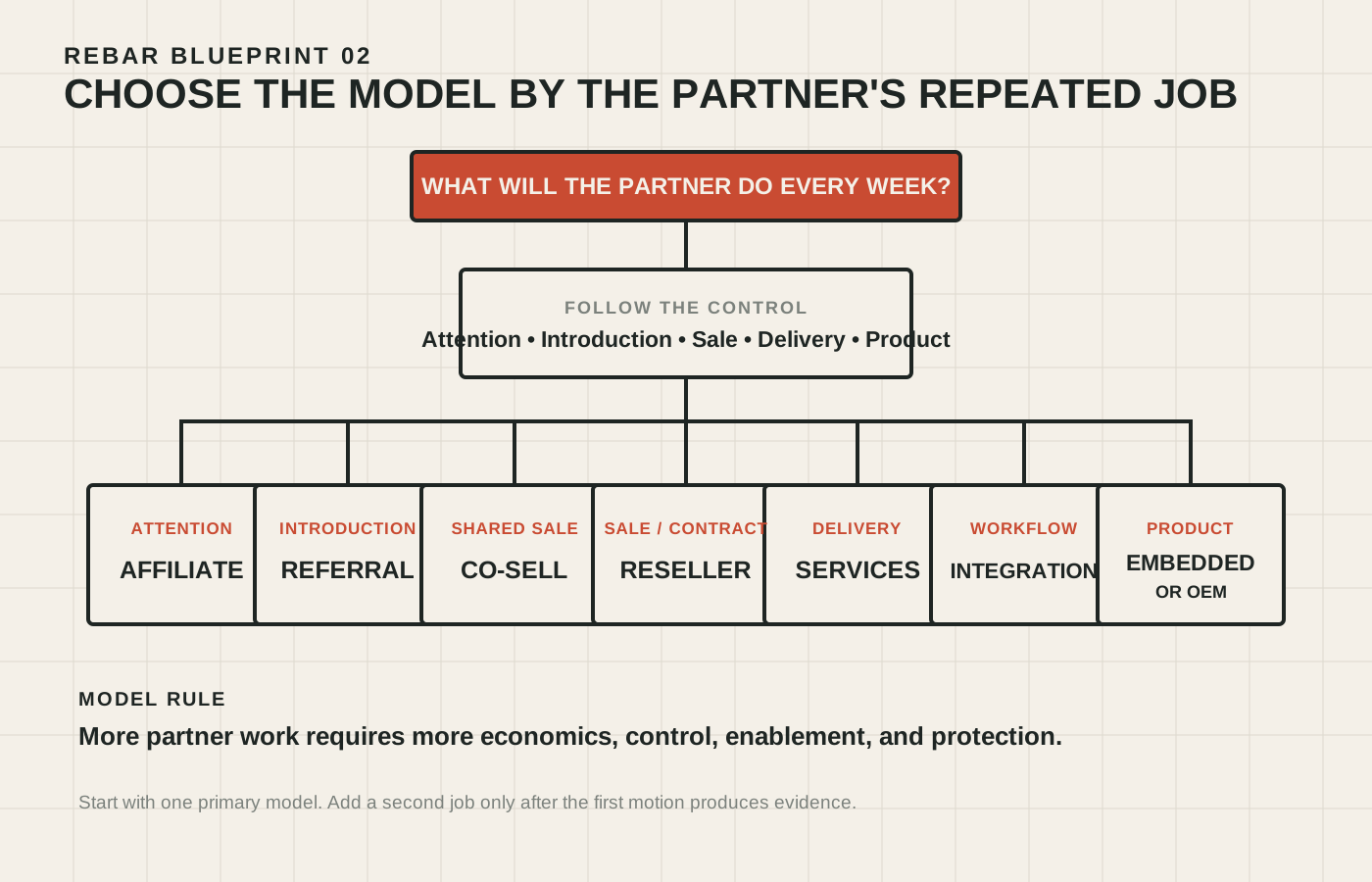
Use the partner's repeated action to choose the starting model. The seven models can work alone or together. Start by naming the primary motion; add another model only when the same partner has a clear second job.
The seven models at a glance
"Operating load" below includes enablement, technical work, support, governance, and conflict management. A model with higher operating load can create more durable revenue, but also costs more to build and maintain.
- Affiliate — the partner sends tracked attention, your company closes the customer; economics are a fee per action or percentage of a transaction; operating load is low.
- Referral — the partner makes a qualified introduction, your company closes; economics are a flat fee or share of closed revenue; operating load is low to medium.
- Co-sell — the partner helps pursue and close a shared account, both companies close; each earns its own revenue, sometimes with a referral fee; operating load is medium to high.
- Reseller — the partner sells your offer as part of its own business, the partner or both close; economics are a wholesale discount or recurring margin; operating load is high.
- Services — the partner implements, configures, or advises around your product; your company usually closes the software and the partner closes services; each earns its own revenue; operating load is medium to high.
- Technology integration — the partner connects two products for a shared use case, each company closes its own contract; each earns its own revenue, sometimes a usage share; operating load is medium to high.
- Embedded or OEM — the partner places your capability inside its product and usually closes the customer; economics are wholesale, usage, license, or revenue share; operating load is very high.
Model 1: Affiliate
An affiliate partner sends measurable attention. The partner publishes a link, code, placement, or offer; your company owns the product, sale, customer, and support. The partner's asset is an audience and the operating action is a tracked response. Affiliate models work best when the product is easy to understand, the buyer can act without a complex sales process, attribution can be tracked, the value of a click or signup is predictable, and the partner can promote the offer without risking a high-trust advisory relationship. Common economics include a fee per qualified action, a percentage of the first purchase, or a recurring share for a fixed period.
The main failure is poor audience fit — a large audience can produce almost no qualified demand. The second failure is fraud or low-quality traffic when the payment event rewards volume without quality control. Plain translation: the partner gets paid for measurable attention and does not sell, implement, or support the product.
Model 2: Referral
A referral partner identifies a likely buyer and makes an introduction; your company runs discovery, sells, contracts, implements, and supports. The partner's asset is access plus enough trust to earn a conversation. Referral models work best when the partner hears the customer problem during normal work, the problem is easy to recognize, your company can take over the sale quickly, the partner wants a return without building a sales capability, and the introduction does not expose the partner to more reputation risk than the fee can justify. Common economics include a flat fee for a qualified opportunity, a percentage of first-year revenue, or a smaller recurring share.
The word 'qualified' needs a written definition. A name in a spreadsheet is not a referral; a qualified referral normally includes a real customer, a relevant problem, permission to connect, and a clear next step. The main failure is expecting the partner to stay involved through a complex sale while paying for a simple introduction. Plain translation: the partner opens the door, your company does the selling and delivery.
Model 3: Co-sell
A co-sell partner helps pursue a shared account because the buyer needs both offers, both forms of expertise, or both relationships. Each company usually keeps its own product, contract, revenue, and customer obligations while coordinating account strategy and buyer communication. Co-sell works best when the products solve adjacent parts of the same problem, both companies have account access or useful information, the buyer benefits from evaluating the offers together, deal size supports joint planning, and sellers on both sides receive credit.
Compensation varies: each company may earn only its own contract value, or one side may pay a referral fee. Internal sales credit often matters more than the external fee — an account executive will ignore a partnership that adds work and threatens quota credit. Co-selling requires account rules: who leads the meeting, how information can be shared, which company owns each action, and how teams handle competing opportunities. The main failure is treating a shared logo list as a joint pipeline. Plain translation: both companies help win the account, and each side needs a reason to prioritize the same deal now.
Model 4: Reseller
A reseller sells your product through its own commercial motion. The reseller may bundle the product, set the price, hold the contract, invoice the customer, provide first-line support, or some combination. The partner's assets are distribution, sales capacity, customer ownership, and often market specialization. Reseller models work best when the partner already sells a related offer to the same buyer, customers prefer to buy through the partner, the partner can explain and demonstrate the product, the product can be packaged and supported consistently, and the margin covers the partner's full sales and service cost.
Common economics include a wholesale price, tiered discount, or recurring margin, with deal registration protecting the reseller when your direct team can pursue the same accounts. A reseller needs more than a deck: pricing rules, sales training, demo access, implementation guidance, support escalation, account protection, and a clear answer when a customer requests a missing feature. The main failure is giving a partner reseller obligations with referral economics. Plain translation: the partner operates a sales business around your product, so pay and support it accordingly.
Model 5: Services and implementation
A services partner helps the customer get value from your product by advising, configuring, migrating data, integrating systems, managing change, training users, or operating the product. The partner's asset is delivery capacity and subject-matter expertise. Services models work best when the product needs implementation or ongoing expert work, customers want advice beyond software support, services make the product easier to buy or more likely to succeed, your company wants product revenue without building a large services team, and the partner can earn enough services revenue to prioritize the relationship.
Each company usually earns its own revenue: yours from the software contract, the partner's from implementation and advisory fees, with a referral fee possible when the partner sources the deal. The economics can align without a large commission — a partner earning $50,000 of implementation work around a $25,000 software contract may care more about service attachment than a license share. The main failure is starving the partner of services by making every implementation 'easy' in the pitch, then asking the partner to generate demand. Plain translation: your product creates paid work for the partner, and the partner makes your product usable for the customer.
Model 6: Technology integration
A technology partnership connects two products so the customer can complete a workflow across them. The partner's asset is product capability and workflow position, and each company usually keeps its own contract and customer relationship. Integration models work best when customers already use both categories, data or actions need to move between the products, the connection removes real manual work or risk, the integration improves acquisition, retention, expansion, or usage for at least one company, and both companies can support the connection after launch.
The integration itself rarely creates demand. Revenue requires a discovery and distribution plan: marketplace placement, in-product prompts, sales enablement, customer success triggers, joint account work, or a packaged use case. The main failure is spending engineering time on a connection with no agreed path to customers. Plain translation: the products work together, but a separate GTM motion still has to put the connection in front of the right customer.
Model 7: Embedded or OEM
An embedded or OEM model places your capability inside the partner's product, workflow, or brand. The end customer may know your company powers the feature, or your company may remain behind the scenes. The partner's assets are product distribution, workflow control, and the primary customer relationship; your company supplies infrastructure or a specialized capability. Embedded models work best when the capability fits naturally inside the partner's product, customers need it at a specific workflow point, the partner wants to own the experience and commercial relationship, your product can support the partner's volume and reporting needs, and long-term revenue can justify the technical, legal, operational, and support work.
Common economics include a wholesale rate, platform license, minimum commitment, usage fee, or revenue share. Embedded partnerships can become durable because the products and operations connect deeply — and the same depth creates risk. Product roadmaps, support processes, data rights, compliance duties, pricing changes, and exit terms need direct treatment. The main failure is building a custom version of the product before proving demand and internal sponsorship. Plain translation: your capability becomes part of the partner's product, so the partner needs more control and your company needs stronger volume protection.
Choose the right partnership model
The Partnership Model Selector in the blueprint compares the seven models against customer ownership, sales work, delivery, technical depth, margin, and operating load.
Get the free blueprint →Marketplace and strategic alliance are containers
A marketplace is a place where customers discover or buy partner offers; it can support affiliate, referral, co-sell, reseller, integration, or embedded motions. A listing alone does not tell you the partnership model — you still need to know who creates demand, who sells, who contracts, and who supports the customer. 'Strategic alliance' is broader, describing a relationship that may include several models, shared product investment, market entry, or a long-term agreement, but the phrase does not replace operating details. Use precise model names in the working plan and save broad labels for external communication.
One partner can support more than one model
A software company might begin as a referral partner. After several successful deals both companies may add co-selling; customer demand may then justify a technology integration; and a few years later the capability may become embedded. That sequence works because each step proves demand, behavior, and economics before adding complexity. A second model can also run beside the first — an implementation firm can earn services revenue and a referral fee. Write the models separately, and give each one its own trigger, owner, economics, obligations, and success measure.
Choose the model by following control
Ask where the partner needs control to do its job. If the partner controls attention, start with affiliate. If it controls a trusted introduction, start with referral. If both companies control part of the buying process, start with co-sell. If the partner controls the sale or contract, start with reseller. If it controls delivery and customer outcomes, start with services. If both products control part of the workflow, start with technology integration. If the partner controls the product experience and primary customer relationship, start with embedded or OEM.
The model should match the partner's natural business. An accounting firm makes money from advice and services. A media company makes money from attention. A distributor makes money from resale. A software platform makes money from product usage and retention. Work with the business model already present; a partnership that asks a company to become a different kind of business will move slowly.
Test the model with one imaginary customer
Before writing an agreement, walk one realistic customer through the full motion and answer these in order. Any unclear answer will become an operating problem later.
- How does the customer become aware of the offer?
- Why does the customer trust the recommendation?
- Who qualifies the need, and who runs the first meeting or product action?
- Who presents pricing, and who signs the contract?
- Who invoices and collects payment?
- Who implements the product or service, and who answers the first support request?
- Who owns renewal and expansion, and what event causes the partner to get paid?
- What happens if the customer is already in both systems?
Common model mismatches
- Referral pay with reseller expectations — the partner gets a modest fee but must learn the product, run discovery, influence the close, and support the account, then goes quiet.
- Integration work with no distribution — engineering ships the connection, but sales and success have no trigger, target list, or offer, so usage stays low.
- Reseller margin with direct-sales conflict — the partner invests in a deal, your team enters the account without registration rules, and the partner stops bringing opportunities.
- Embedded work before commercial proof — both teams begin technical design while the partner has no committed launch owner, target users, forecast, or minimum volume.
- Co-sell plans without seller credit — leadership approves the alliance, but account executives get no quota credit for joint work, so sellers return to deals that pay them.
Choose one primary motion
A clear model makes a partnership easier to recruit, price, operate, and measure. Name the partner's repeated job. Match the economics to the work. Give the partner enough control to perform the job. Keep the first version narrow enough to test with real customers, and add complexity only after the simple motion produces evidence.
Choose the right partnership model
Download The Partner-Led Growth Blueprint. The Partnership Model Selector compares the seven models against customer ownership, sales work, delivery, technical depth, margin, and operating load.
Get the free blueprint →Common questions
What are the main types of B2B partnerships?
The main operating models are affiliate, referral, co-sell, reseller, services, technology integration, and embedded or OEM. Marketplaces and strategic alliances can contain several of these models.
What is the difference between referral and reseller partnerships?
A referral partner makes an introduction and your company owns the sale. A reseller sells your product through its own commercial motion and may own pricing, contracting, invoicing, implementation, or support. The reseller performs more work and needs more margin and control.
What is the difference between co-selling and a referral?
A referral usually ends after the qualified introduction. In a co-sell motion, both companies help pursue and close the account. Co-selling needs joint account planning, clear roles, information-sharing rules, and internal sales credit.
Do technology integrations generate partner revenue?
An integration can improve the customer outcome, but the connection needs a GTM motion. Marketplace placement, in-product discovery, sales enablement, customer success triggers, or joint account work must bring the use case to customers.
Can one company use several partnership models?
Yes. One company can run different models with different partner types, and one partner can support several models. Each model needs its own job, trigger, economics, obligations, and measures.
Which partnership model should a startup use first?
Use the lowest-complexity model that can test the customer outcome and partner behavior. Many startups begin with referral, co-sell, or services because those models can test demand before a deep technical build. The right answer depends on the partner's scarce asset and the customer's buying process.
Related reading

Why Partnerships Work: A First-Principles Guide
A partnership works when the customer, the partner, and your company all gain from the same transaction. Start with that equation.

How to Choose Your Go-to-Market Strategy from First Principles
Choose a GTM motion based on deal economics, buying friction, trust, time to value, and where useful distribution already exists.

Partnerships vs. Your First Sales Hire: The Math for Founders
Before you sign off on a $150K sales hire, run the math against a partner motion you operate yourself. For most SMBs under $5M, the partner system wins the first bet.

The Partner One-Pager: The Asset That Turns a Warm Reply Into a Meeting
A warm reply dies when you send a deck. The page that gets forwarded is one page, about their customer, with a number on it. Template and the email that carries it.