
Companies often choose a go-to-market strategy as if they are choosing an identity. They want to be product-led because the model looks efficient. They add account-based marketing because enterprise companies use it. They hire salespeople because a competitor has a sales team. They start partnerships because direct pipeline slowed down. Each decision can be reasonable. The order is backward.
A go-to-market strategy is the system that moves a specific customer from a problem to recurring value at an acceptable cost. Choose the primary motion based on buying friction, deal economics, required trust, time to value, and where useful distribution already exists. The main B2B motions are sales-led, product-led, marketing-led, community-led, and partner-led. Most companies use a combination, but one motion should still carry primary responsibility for getting the customer into value.
Every GTM strategy must do the same work
No matter which label a company uses, its GTM system must complete six jobs: find the right customer, make the problem important, create trust, help the buyer decide, deliver first value, and earn the next dollar. The motions differ because a different actor does most of the work. In sales-led growth, people carry the motion. In product-led growth, the product carries much of it. In marketing-led growth, content, campaigns, and demand systems carry it. In community-led growth, peers and shared participation create access and trust. In partner-led growth, another company carries part of the motion.
Your market already imposes constraints. A buyer facing a high-risk, company-wide decision needs more trust and decision support than a person testing a $20 tool. A $20 tool cannot fund six months of enterprise selling. A complex product that takes twelve weeks to implement cannot rely on an instant self-serve experience that does not exist. Start with the buying reality.
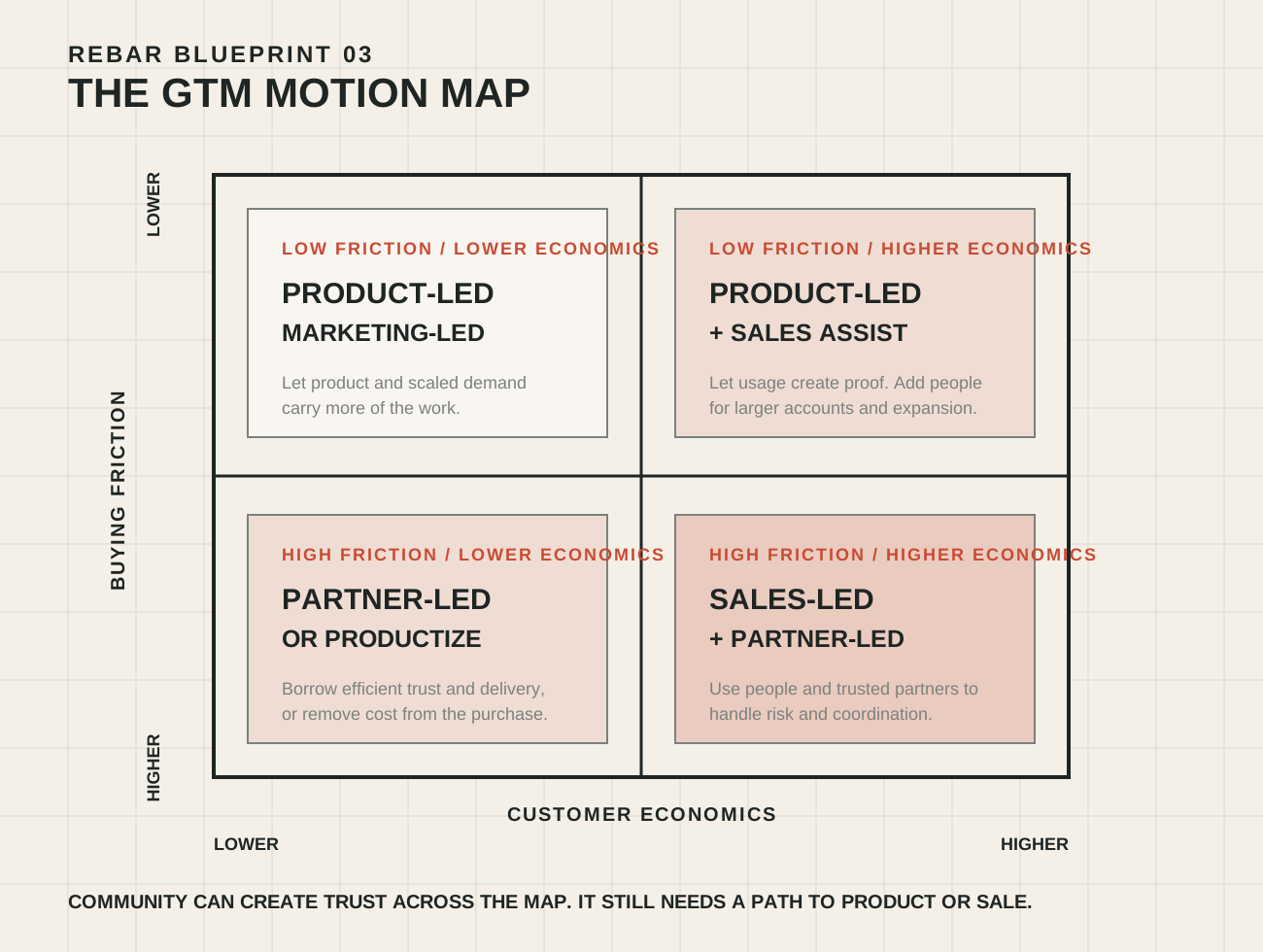
The GTM motion map
Two variables eliminate many bad options quickly. Buying friction: how much trust, coordination, change, risk review, and implementation stand between interest and value? Customer economics: how much gross profit can one customer produce over a reasonable period? The matrix is a starting point, not a replacement for customer evidence, but it forces the basic economic question: can the expected customer value pay for the work required to win and serve the customer?
The GTM equation
A viable motion creates more expected gross profit than the full cost of moving the customer through the system: expected customer gross profit must exceed the cost of demand, trust, sale, onboarding, partner share, and ongoing service. Include the costs hidden across departments — founder time is a cost, free implementation is a cost, content production is a cost, partner commission is a cost, product onboarding is a cost, customer success is a cost. The cheapest-looking motion can become expensive when it fails to convert or retain customers. The right comparison is total cost per successful, retained customer.
Motion 1: Sales-led growth
Sales-led growth uses people to identify, educate, qualify, persuade, and coordinate buyers through a decision the product or website cannot complete alone. It fits when contract value can support human selling, the purchase involves several stakeholders, the buyer needs security, legal, financial, or operational review, the product needs configuration or a tailored business case, the market contains a manageable number of valuable accounts, and the seller can create useful insight during the buying process. The model can source leads from outbound, inbound, events, ABM, or partners — sales-led describes how the decision gets made, not where every lead comes from.
The main constraint is cost: hiring more sellers before the company has a repeatable problem, buyer, message, and process multiplies payroll faster than learning. The main risk is using salespeople to compensate for product friction customers will not tolerate after the sale. Plain translation: a person helps the buyer make a complex or valuable decision, and the deal must produce enough gross profit to pay for that work. Watch qualified pipeline created, win rate by segment, sales cycle length, gross profit per closed customer, acquisition payback, time to first value, and retention and expansion by seller cohort.
Motion 2: Product-led growth
Product-led growth lets the customer discover value by using the product before a traditional sales process; the product handles education, activation, conversion, and some expansion. It fits when one user or a small team can begin without a company-wide decision, the product delivers useful value quickly, setup requires little custom work, usage creates a natural reason to pay or expand, the buyer can understand pricing and risk without extended negotiation, and the market contains enough users to support a scaled funnel. Free trials do not make a company product-led; the product must carry meaningful GTM work. A trial that always requires a salesperson and manual setup is a sales-led motion with a demo environment.
The main constraint is product readiness — strong onboarding, clear value, instrumentation, pricing, lifecycle communication, and support — which moves work from sales into product and growth teams. The main risk is generating many users who never reach value and treating signup volume as proof of demand. Plain translation: the product earns the next step by showing value, and the user should not need a committee or consultant to begin. Watch visitor-to-signup conversion, activation rate, time to first value, free-to-paid conversion, usage depth and frequency, team or account expansion, and retention by activation path.
Motion 3: Marketing-led growth
Marketing-led growth uses content, search, advertising, media, events, and campaigns to create demand and move buyers toward a transaction that may be self-serve or sales-assisted. It fits when buyers actively research the problem, the company can teach something useful before a sales conversation, the offer and audience are clear, market volume supports repeatable demand creation, a standard message can move many similar buyers, and the economics can fund content, distribution, and follow-up. Inbound and outbound are directions of contact, not complete strategies — search content can feed a sales-led motion, targeted ads can support a partner campaign, and outbound email can recruit users into a product-led offer.
The main constraint is attention, so useful distribution often matters as much as content quality. The main risk is optimizing for leads that look active in a dashboard and have little intent to buy. Plain translation: marketing earns attention and trust at scale, and the handoff to product or sales must preserve the reason the buyer responded. Watch qualified demand by segment, cost per qualified opportunity or activated user, conversion by source and message, revenue and gross profit by campaign, time from first touch to first value, acquisition payback, and direct, branded, and returning demand over time.
Motion 4: Community-led growth
Community-led growth creates value through ongoing participation among people with a shared role, problem, market, or identity. Members learn from one another, and the resulting access, trust, and insight can produce demand, adoption, and retention. It fits when buyers learn from peers before deciding, the problem changes often enough to support ongoing discussion, members can create value without constant vendor promotion, the company can support the community before capturing revenue, participation improves the product or professional identity, and trust strongly affects category choice. A branded audience is not automatically a community — a newsletter has subscribers, an event has attendees, a community has members who contribute to one another.
The main constraint is time; real communities develop through useful interaction and credible stewardship and resist a forced quarterly pipeline target. The main risk is turning the community into a disguised lead list, and members leave when every discussion becomes a sales surface. Plain translation: peers create access and trust, and the company earns commercial value by supporting a place that has independent value to its members. Watch active contributing members, member-to-member interactions, return participation, activation or pipeline from relevant moments, retention differences between members and non-members, customer insight applied to product, and revenue influenced over a long enough period.
Motion 5: Partner-led growth
Partner-led growth uses another company to create, influence, sell, deliver, or retain revenue. The partner contributes customer access, trust, capability, workflow position, or service capacity. It fits when buyers already rely on trusted intermediaries, a platform or service provider sits near the moment of need, your company cannot reach the market efficiently through direct sales or marketing alone, the customer needs a combined product or service outcome, another company can implement or support the product more efficiently, and both companies can gain enough value to repeat the motion. Partner-led growth can support every other motion — a reseller can carry sales-led growth, an integration can improve product-led activation, an association can distribute marketing content, and a professional community can become a referral surface.
The primary constraint is indirect control: you cannot manage the partner's priorities as if the partner were an employee, so the motion must fit the partner's economics and operating rhythm. The main risk is confusing partner recruitment with customer acquisition — signed partners produce no growth until they perform a repeated customer-facing action. Plain translation: another company already owns part of the access, trust, product, or work needed to win the customer, and the partnership pays that company to use the asset in a repeatable way. Watch qualified partners in profile, activated partners performing the target action, time to first customer action, time to first revenue, second-action rate, partner-sourced and partner-influenced gross profit, cost to recruit and support each producing partner, and revenue concentration by partner.
Compare the five GTM motions
- Sales-led — the seller is the primary engine; strong fit for a complex, valuable, multi-stakeholder purchase; the structural constraint is human cost and ramp time; fast proof is a qualified buyer advancing through a real decision.
- Product-led — the product is the engine; strong fit for a fast, low-friction path to individual or team value; the constraint is product and onboarding readiness; fast proof is a user reaching value and returning.
- Marketing-led — content and campaigns are the engine; strong fit for a searchable problem with a repeatable audience and clear offer; the constraint is attention and distribution; fast proof is qualified demand converting to product or sales action.
- Community-led — peers and participation are the engine; strong fit for a trust-heavy category with recurring shared problems; the constraint is time and stewardship; fast proof is members creating useful value for one another.
- Partner-led — another company is the engine; strong fit where existing access, trust, workflow, capability, or service capacity is present; the constraint is indirect control and shared economics; fast proof is a partner repeating a defined customer action.
Score your GTM motion
The GTM Motion Scorecard in the blueprint compares sales-led, product-led, marketing-led, community-led, and partner-led growth against your buyer concentration, purchase friction, customer economics, time to value, trust, and existing distribution.
Get the free blueprint →Choose the motion with six facts
Buyer concentration: how many plausible buyers exist and how easy are they to identify? A narrow market with a few thousand valuable accounts supports targeted sales; a broad market with millions of users needs product or marketing leverage; a fragmented vertical served by a few advisors or platforms can favor partners. Purchase friction: count stakeholders, approvals, integrations, legal and security reviews, budget cycles, behavior change, and implementation work — higher friction usually needs more human trust through sales or partners.
Customer economics: how much gross profit can a successful customer produce and how long does it take? Use gross profit rather than headline contract value, including delivery, support, infrastructure, partner share, and retention. Time to value: fast, independent value supports product-led motion, while slow value with many dependencies needs sales, services, partners, or a combination. Trust requirement: low-risk tools can earn trust through product use and clear proof, while high-risk categories rely on expert sellers, references, advisors, platforms, or communities. Existing distribution: look for software platforms, consultants, agencies, service providers, associations, marketplaces, distributors, financial institutions, and adjacent vendors — a partner route becomes attractive when one of these reaches the buyer with more relevance or lower cost than your direct team.
Account-based marketing is a targeting system
Account-based marketing helps a company focus sales and marketing resources on a defined set of accounts. It can improve a sales-led or partner-led motion and can identify high-value users for a product-led sales assist. ABM does not answer the full GTM question — the company still needs a customer problem, offer, trust path, sales or product experience, onboarding model, and viable economics. Use ABM when account concentration and deal value justify coordinated attention; do not use the label to make generic outbound look strategic.
Build a hybrid motion with one primary engine
Most B2B companies become hybrid. The useful question is which motion owns entry and which motion removes a bottleneck. Product-led with sales assist: the product creates initial value, and sales helps larger accounts with security, procurement, rollout, and expansion. Sales-led with partners: partners create access, trust, or implementation capacity, and sales owns discovery, commercial decisions, and the contract. Marketing-led with community: content helps people find the company, community creates deeper peer value, and product or sales handles the transaction. Partner-led with an embedded product: the partner owns distribution and the primary customer experience while your product delivers the underlying capability with little direct selling. Community-led with product-led entry: the community builds trust, and a self-serve product lets members apply the learning without waiting for a sales process.
Name the primary motion in one sentence: 'We reach [specific customer] through [primary motion] because [economic or buying reason]. We use [supporting motion] to remove [specific bottleneck].' If the team cannot complete that sentence, it probably has a collection of tactics instead of a GTM strategy.
Run a 90-day GTM test
A GTM strategy becomes useful when it produces evidence, so keep the first test narrow. Work through the steps below in order. One focused test gives the team a common learning loop; five motions running at once give every result a different explanation.
- Choose one customer and one painful situation — define the segment, buyer, trigger, and current alternative. A broad industry is not a segment.
- State the motion hypothesis — explain why the chosen motion fits the buying process and economics, and name the actor that will create access and trust.
- Build one entry offer — give the customer a clear first action (assessment, trial, working session, pilot, benchmark, or purchase) that produces evidence of the problem or a small unit of value.
- Track the full path — measure movement from first contact through first value; do not stop at leads, meetings, signups, or signed partners.
- Review economics and behavior — find where the motion loses customers, time, or money, and compare the actual work with expected customer gross profit.
- Continue, change, or stop — continue when customers move and economics can improve with repetition, change the bottleneck when demand stays credible, and stop when behavior or economics contradict the thesis.
Choose the route the market can support
Your GTM strategy should reflect how customers already buy, what the product can deliver, and what the economics can fund. Sales helps a buyer through complexity. Product lets a buyer experience value directly. Marketing earns attention at scale. Community builds peer value and trust. Partners contribute distribution, trust, capability, workflow position, or delivery capacity. Choose the primary engine, use supporting motions to remove specific constraints, and measure the path through first value and retention. The market will tell you whether the design works.
Score your GTM motion
Download The Partner-Led Growth Blueprint. The GTM Motion Scorecard compares sales-led, product-led, marketing-led, community-led, and partner-led growth against your buyer concentration, purchase friction, customer economics, time to value, trust, and existing distribution.
Get the free blueprint →Common questions
What is a go-to-market strategy?
A go-to-market strategy is the system that moves a defined customer from a problem to recurring value at an acceptable cost. It covers customer selection, access, trust, evaluation, transaction, onboarding, retention, and expansion.
What are the main B2B go-to-market motions?
The main motions are sales-led, product-led, marketing-led, community-led, and partner-led growth. Most companies use a combination, with one motion serving as the primary engine.
What is the difference between a GTM strategy and a sales strategy?
A sales strategy explains how sellers find, qualify, persuade, and close customers. A GTM strategy covers the full route from market selection through acquisition, first value, retention, and expansion. Sales can be one part of the GTM system.
What is the difference between sales-led and product-led growth?
Sales-led growth uses people to help buyers through a valuable or complex decision. Product-led growth lets users experience value through the product before a traditional sale. Purchase friction, time to value, and customer economics determine which motion fits.
When should a company use partner-led growth?
Use partner-led growth when another company owns useful customer access, trust, capability, workflow position, or service capacity. The partnership must produce a better customer outcome and enough value for both companies to repeat the work.
Can product-led and partner-led growth work together?
Yes. A partner can distribute a self-serve product, embed it in another workflow, improve activation through an integration, or identify accounts ready for sales assistance. Define which motion owns each stage of the customer path.
Is account-based marketing a GTM strategy?
Account-based marketing is a targeting and coordination system. It usually supports a sales-led or partner-led GTM motion. The company still needs an offer, trust path, buying process, onboarding model, and viable economics.
Related reading

Why Partnerships Work: A First-Principles Guide
A partnership works when the customer, the partner, and your company all gain from the same transaction. Start with that equation.

The 7 B2B Partnership Models: How Each One Works
A partner label tells you who is involved. The partnership model tells you how the customer, work, control, and money move.

Partner-Led Growth for SMBs: The System Founders Skip
Partner-led growth means other companies bring you revenue because it pays them to. Most founders skip it because they think it requires a partnerships hire. It requires a system.

How to Use Grok Bot for Sales Lead Generation
Build a repeatable Grok Bot prospecting workflow with a clear customer profile, dated buying signals, evidence-based qualification, and outreach drafts. Includes a complete Bot brief, a lead scorecard, and a daily routine prompt.